


 Nov 17, 2026
Fourth Amendment to the GNA Regulations: A Step Towards Greater Flexibility in Connectivity and Transmission Access
Introduction
The Central Electricity Regulatory Commission (“CERC”) notified the Central Electricity Regulatory Commission (Connectivity and General Network Access to the Inter-State Transmission System) Regulations, 2022 (“GNA Regulations”) on June 7, 2022, establishing the framework for grant of connectivity and general network access (“GNA”) to the inter-state transmission system (“ISTS”). The GNA Regulations were subsequently amended on April 1, 2023, June 19, 2024 and August 31, 2025.
On November 11, 2026, the CERC notified the Central Electricity Regulatory Commission (Connectivity and General Network Access to the Inter-State Transmission System) (Fourth Amendment) Regulations, 2026 (No. L-1/261/2021/CERC) (“Fourth Amendment”).
It addresses a range of practical difficulties faced by generating companies, renewable energy developers, energy storage developers and drawee entities in obtaining and utilising connectivity and GNA. It is of particular relevance given the delays in the development of transmission infrastructure, the increasing deployment of renewable energy and energy storage systems (“ESS”), and the need for greater flexibility in the use and transfer of existing connectivity.
Broadly, the Fourth Amendment introduces a time-bound mechanism for withdrawal of connectivity, facilitates access during non-solar hours, provides greater flexibility in meeting project development milestones, accelerates the return of certain bank guarantees and enables the transfer of connectivity and GNA in specified circumstances. The key highlights, and their implications, are set out below.
1. Withdrawal of connectivity and closure of applications
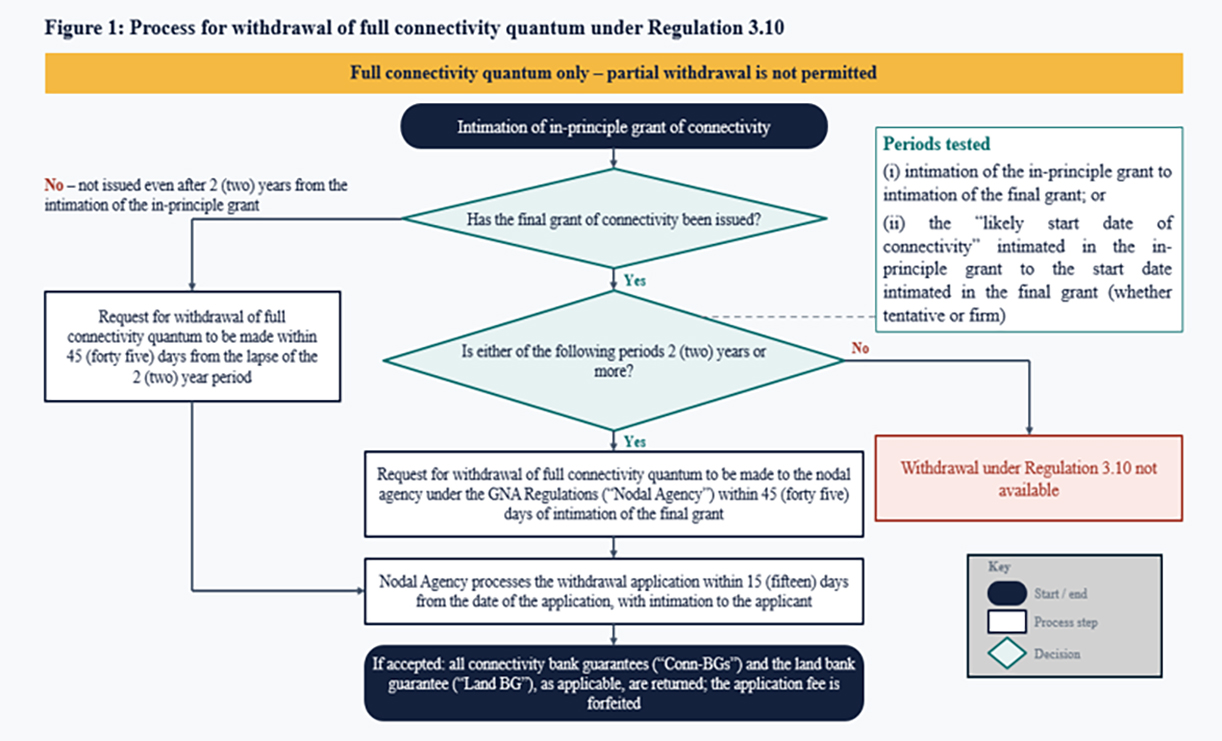
The Fourth Amendment inserts a new Regulation 3.10 which, notwithstanding the existing withdrawal provisions in Regulations 3.7 to 3.9, permits an entity to seek withdrawal of its full connectivity quantum where the grant or commencement of connectivity has been delayed. Partial withdrawal is not permitted. The eligibility conditions, timelines and consequences of withdrawal, including the transition window under the new Regulation 37.11, are set out in the diagram below.
(Regulation 37.11(a) refers to the lapse of “30 days after lapse of two years” from the in-principal grant and cross-refers to Regulation 3.10(c). This appears to be a drafting error, since Regulation 3.10(b) provides a 45-day window for this scenario and Regulation 3.10(c) deals with processing of the withdrawal application. Clarification from CERC may be required.)
Separately, and unlike a withdrawal under Regulation 3.10 (where the application fee is forfeited), Regulation 6.3 has been substituted to require the Nodal Agency to close an application and return all bank guarantees, along with the full application fee, where it is unable to carry out the interconnection study on account of load generation balance or other associated issues, or where the identified augmentation (with or without the associated transmission system) is not approved by the competent authority. Closure is to be in accordance with a Detailed Procedure to be formulated by the Nodal Agency in consultation with stakeholders, which will also govern pending applications and existing grants covered by these grounds.
Implications: These provisions provide an exit route for developers who would otherwise remain locked into connectivity despite significant delays in the availability of transmission infrastructure. However, the 45 (forty five) day window and the all-or-nothing nature of the withdrawal under Regulation 3.10 (as illustrated above in Figure 1) will require applicants to assess their position promptly upon receipt of the final grant or the lapse of the 2 (two) years, and the forfeiture of the application fee remains a cost of exit.
2. Non-solar hour access and ESS requirements
The Fourth Amendment inserts new Regulations 4.7 and 4.8 to provide greater flexibility in obtaining connectivity for solar and non-solar hours.
Under Regulation 4.7, a renewable energy generating station (“REGS”) or an ESS with an installed capacity of 50 (fifty) MW and above, either individually or in aggregate through a Lead Generator or Lead ESS, may seek connectivity for non-solar hour access at substations other than those covered under Regulation 4.5(a). The Central Transmission Utility of India Limited (“CTUIL”) is required to publish a list of such substations, along with the margin available for non-solar hour access and update it monthly. Under the new clause 2A of Annexure-IV, such applications will be processed only within available margins, and no ISTS augmentation will be undertaken for them. The applicant must also enter into an agreement with the entity originally allocated the bay for sharing the dedicated transmission system, including charges for its use in proportion to their respective connectivity quanta as mutually agreed, and submit it to the Nodal Agency within six months of the final grant. Such entities are also liable to furnish Conn-BGs and pay one-time GNA charge.
Regulation 4.8 permits an application for connectivity with full-day access under Regulation 4.1 to be converted into an application for solar hour access or non-solar hour access, based on the availability of margin declared during the consultation meeting, and vice versa. The Nodal Agency will process the converted application once the applicant furnishes its written consent.
The Fourth Amendment also prescribes a minimum energy capacity for ESS. Regulation 4.1(c) now requires a minimum energy capacity (in MWh) of twice the power capacity (in MW), or such capacity as may be notified by the Central Electricity Authority as per system requirement. A corresponding proviso has been added to Regulation 5.11 for ESS with REGS i.e. if ESS does not meet this requirement, the REGS will not have injection scheduling rights under GNA for the ESS during non-solar hours.
Implications: These changes should facilitate better utilisation of the existing transmission network, particularly during periods when solar generation is unavailable and transmission capacity may otherwise remain underutilised. The ability to convert between full-day and time-specific access may also allow developers to align connectivity more closely with the generation profile of their projects. However, access under Regulation 4.7 will depend on the margins published by CTUIL and on commercial arrangements with the entity holding the bay, and ESS will need to satisfy the prescribed energy capacity requirement.
3. Connectivity applications and project development
The Fourth Amendment also revises the manner in which applicants may obtain connectivity and satisfy the conditions subsequent to its grant.
Installed capacity and additional capacity
A new proviso to Regulation 5.1 clarifies that capacity for meeting technical compliances at the point of injection, as confirmed by the Nodal Agency after studies, will not be counted in the installed capacity for the purpose of seeking connectivity to the ISTS. For additional capacity under Regulation 5.2, an application fee of INR 5 (five) lakh (for 50 (fifty) MW and above) or INR 1 lakh (for less than 50 (fifty) MW), plus applicable taxes, is now payable, and the Land BG may be furnished either by the existing connectivity grantee or by the entity installing the additional capacity. Where the additional capacity is ESS, it may install REGS solely for charging the ESS, and the land and financial closure documentation requirements will not apply to such REGS. The connectivity for additional capacity remains tied to the underlying grant: if the existing grantee relinquishes, or suffers revocation of, its full connectivity quantum, the connectivity for the additional capacity also stands relinquished or revoked, while a partial relinquishment or revocation restricts it to the balance quantum. Certain conditions of Regulation 5.2 have also been disapplied for additional capacity installed to meet technical compliance and for additional capacity that does not result in additional solar or non-solar hour access.
Land documentation
Regulation 5.8 now permits sub-lease documents (where the lease permits sub-leasing) to be furnished as land documents. Sub-leases are permitted only between a parent and its subsidiaries (and vice versa) or between subsidiaries of the same parent, or where leased Government land is sub-leased to another entity under Government policy. This accommodates group structures commonly used for project land while restricting sub-leasing to unrelated parties. Separately, the Land BG for an ESS (excluding pumped storage plants (“PSP”)) under Regulation 5.8(xi)(c) has been set at INR 5 (five) lakh/MW.
Multi-location projects
The provisos to Regulation 5.8(xi)(a) governing multi-located REGS (being REGS located in one or more States and connected at different substations) under a single Letter of Award (“LoA”) or Power Purchase Agreement (“PPA”) have been substituted. An applicant may obtain connectivity at one or more locations, up to the quantum awarded under the LoA or contracted under the PPA, or the installed capacity provided in the LoA or PPA at such location, whichever is lower. An applicant may also combine the LoA or PPA route with the land or Land BG route at a location through a single application. In such a case, the LoA or PPA quantum at that location must be exhausted first, up to the connectivity quantum, before any balance can be used at another location, and the Nodal Agency will treat the full quantum at that location as a single generating station, with the scheduled commercial operation date (“SCOD”) determined by the LoA or PPA. This should assist developers implementing projects across multiple States and substations under a single procurement arrangement.
Post-grant timelines and documentation
The timelines and documentation requirements under Regulation 11A have been revised. A REGS (other than a hydro generating station) or ESS (excluding PSP) holding connectivity under Regulation 5.8(xi)(a) must submit land documents within 60 (sixty) days of the effective date of GNA, if these have not already been furnished, and non-compliance has been brought within Regulation 11B(1). Further, REGS and ESS, as well as renewable power park developers, must furnish financial closure documents within 30 days of the effective date of GNA. These comprise a loan sanction letter, proof of first disbursal of the loan or, where 100% of the project cost is to be internally funded, a Board resolution, along with net worth and other details as per the Detailed Procedure. An entity that has achieved commercial operation date (“COD”) for its full capacity by the last date for furnishing these documents is exempt. Under the transition provisions, an entity under Regulation 5.8(xi)(a) whose last date for furnishing financial closure documents falls within two months of the Fourth Amendment becoming effective, but for which the date six months prior to the SCOD falls beyond those two months, will be given an additional two months.
Compliance through group companies
The substituted Regulation 11A(5) permits the conditions subsequent under Regulation 11A, and the achievement of COD, to be met by the grantee, its parent company, its subsidiaries or other subsidiaries of its parent. However, all responsibilities under the GNA Regulations, including the submission of documents, continue to rest with the entity to which the in-principle or final grant was issued. Documents furnished in the name of a group company must be accompanied by authorisation from that company enabling the grantee to submit them to the Nodal Agency.
Conversion to the PPA route
An entity holding an in-principle or final grant under the land or Land BG route may apply to convert to the PPA route upon furnishing an eligible PPA, for part or full capacity, entered into by itself or a group company. The conversion must comply with Regulation 5.8(xi)(a), including the multi-location provisos. Multiple applications (including enhancement applications) granted at the same terminal bay or substation may be converted into a single application under the PPA route. Where the quantum remaining under the land or Land BG route after conversion is less than 50 (fifty) MW, it is treated as relinquished; Conn-BG3 and any Land BG for that quantum are returned, while Conn-BG1 and Conn-BG2 are retained against the converted quantum.
Change of source
A second change of source is now permitted under Regulation 9.3.5, subject to a fee of INR 20,000 (twenty thousand)/MW (of the gross change in source capacity) or INR 10 (ten) lakh per application, whichever is higher. Where the second source change requires a change of land parcel and the one change permitted under Regulation 5.10 has already been used, a second change of land parcel is permitted on payment of a combined fee of INR 25,000 (twenty five thousand)/MW or INR 10 (ten) lakh per application, whichever is higher. The fee must be paid within 15 days of intimation by the Nodal Agency, failing which the permission stands revoked. In addition, the reference in Regulation 9.3.1 to 18 (eighteen) months prior to the firm start date of connectivity has been reduced to six months, allowing source change requests to be made closer to that date.
Implications: These amendments give developers greater flexibility in structuring land arrangements, utilising group-company resources and modifying project configurations. The multi-location provisions are particularly relevant where a single PPA covers projects at multiple locations. At the same time, the revised land and financial closure timelines will require developers to align their documentation and financing with the effective date of GNA, and the fees for second source and land parcel changes are likely to discourage repeated changes in project configuration.
4. Transfer of connectivity and GNA
The Fourth Amendment introduces express provisions for the transfer of connectivity and GNA in specified circumstances.
Under the new Regulation 15.5, where a generating station or ESS that has achieved COD is transferred to or acquired by another entity, the connectivity for that generating station or ESS is also transferred to the transferee. Subsisting Conn-BGs may be substituted in the transferee’s name, and the Nodal Agency will make consequential changes to the Connectivity Agreement. Regulation 15.4 provides that Regulations 15.1 to 15.3 are subject to the change in control permitted under Regulation 11A(6).
Separately, the new Regulation 23A provides for the transfer of GNA. GNA granted under Regulation 17.1(ii) to (v)[1] for drawal at a single point for an identified load may be transferred to the new owner of that load, once the GNA is effective. Where a State Transmission Utility (“STU”) has been granted GNA under Regulation 17.1(i) on behalf of an entity for such a load, the entity may, through the STU, seek transfer to the new owner after the GNA becomes effective. GNA granted under Regulation 17.1(vi) may be transferred to the acquirer of the generating station or ESS, but only after the generating station or ESS has declared commercial operation and the GNA is effective.
In each case, all dues of the original grantee must be cleared, Conn-BGs must be substituted in the transferee’s name, and the Nodal Agency will make consequential changes to the GNA Agreement.
Implications: These provisions bring welcome clarity to asset acquisitions, corporate restructurings and transactions involving identified loads or operational generation assets. By setting out the conditions for transfer expressly, they should reduce uncertainty in such transactions. However, transfer of GNA for generation assets are available only after COD and once the GNA is effective, and the clearance of dues and substitution of Conn-BGs will need to be factored into transaction timelines.
5. Dual connection for drawee entities
The new Regulation 17.5 permits dual connection for drawee entities. A drawee entity with connectivity to an intra-State transmission system or distribution system may seek to connect directly to the ISTS, as an applicant under Regulation 17.1(iii), for the full quantum or part quantum (of not less than 50 (fifty) MW) of its drawal capacity. It must obtain the consent of the concerned STU and distribution licensee, as applicable, clearly specifying the quantum of connectivity to the intra-State system, and the STU and distribution licensee may process such consent in a time-bound manner to facilitate open access.
Conversely, a GNA grantee under Regulation 17.1(iii) may connect to the intra-State transmission system or distribution system for part or full quantum of its GNA, in terms of the applicable State regulations, after obtaining the Nodal Agency’s consent that such connection is technically feasible.
In either case, the entity must continue to pay the applicable charges under the Electricity Act, 2003 and the regulations framed thereunder for both connections, which may include cross-subsidy surcharge, additional surcharge, transmission charges, wheeling charges, standby charges or any other charges approved by the Appropriate Commission. These provisions do not apply to entities holding GNARE (as defined in the GNA Regulations) unless the GNARE is converted to GNA.
Implications: The provision offers large consumers greater flexibility to source power through both the ISTS and intra-State networks and may be of particular interest to bulk consumers seeking to optimise their procurement. However, the continued liability for charges on both connections, and the dependence on STU and distribution licensee consent, will need to be factored into the commercial assessment of such arrangements.
6. Return of bank guarantees and one-time GNA charge
The Fourth Amendment significantly shortens the period for which certain bank guarantees remain outstanding. The revised timelines, the corresponding transition provisions and the consequences of non-payment are summarised in the table below.
Table 1: Revised timelines for return of Conn-BG2 and Conn-BG3 and payment of the one-time GNA charge
| Item | Provision | Revised timeline under the Fourth Amendment | Conditions and consequences |
| Return of Conn-BG2 and Conn-BG3 (generation capacity) | Regulation 16.2 (amended) | Within one (1) week after the expiry of a year from the declaration of COD of the corresponding generation capacity | – |
| Return of Conn-BG2 and Conn-BG3 (specified additional GNA) | Regulation 37.6 | Within one week after the expiry of one year from the date of effectiveness of the GNA | – |
| Return of subsisting Conn-BG2 and Conn-BG3 (existing cases where one year from COD, or from the effectiveness of additional GNA under Regulation 37.6(1)(a) or (b), has already elapsed) | Transition provisions | Nodal Agency to return within one month | Subject to clearance of any transmission charge dues under the CERC (Sharing of Inter-State Transmission Charges and Losses) Regulations, 2020 (“Sharing Regulations”) |
| One-time GNA charge of INR 1 (one) lakh/MW (entities under Regulation 4.1 and Regulation 17.1(iii)) | One-time GNA charge | Within 15 (fifteen) days of the effective date of GNA | If not paid, recovered by encashing Conn-BG1, Conn-BG2 and Conn-BG3, as required; where no Conn-BGs subsist, the entity is not eligible to carry out any transactions with the grid until the charge is paid; proceeds are used to reduce the monthly transmission charges under the Sharing Regulations |
Implications: The accelerated return of Conn-BG2 and Conn-BG3 (as set out in Table 1) should improve liquidity for generating companies and reduce the period for which bank limits remain blocked after COD. Conversely, the revised timeline for the one-time GNA charge requires entities to ensure that funds are available shortly after GNA becomes effective, particularly where no Conn-BGs subsist and non-payment would bar transactions with the grid.
Conclusion
The Fourth Amendment represents a series of targeted changes to the existing connectivity and GNA framework, rather than a fundamental restructuring of the regime. Its principal focus is on providing greater flexibility to developers and consumers while addressing practical issues relating to transmission availability, project implementation and the transferability of connectivity rights.
The introduction of non-solar hour access, a time-bound withdrawal mechanism, greater flexibility in land and PPA arrangements, and express provisions for the transfer of connectivity and GNA are particularly relevant in the context of evolving renewable energy and energy storage landscape. Equally, the revised bank guarantee timelines and the dual connection framework may have a direct bearing on project financing and power procurement arrangements.
Importantly, the transition provisions in Regulation 37.11 extend several of these benefits, including the withdrawal option and the accelerated return of Conn-BG2 and Conn-BG3, to existing applicants and grantees, which should be of immediate interest to developers with projects in the pipeline.
The effectiveness of several of these changes will, however, depend on their implementation by the Nodal Agency. Within 60 (sixty) days of notification of the Fourth Amendment and after stakeholder consultation, the Nodal Agency is required to revise the Detailed Procedure and submit it to CERC for information, and to submit for CERC’s approval a detailed procedure under Regulation 24.6 addressing, among other things, changes in installed capacity and energy source and the treatment of connectivity, access and Conn-BGs on partial relinquishment or revocation. Overall, the Fourth Amendment is a constructive step towards making the connectivity and GNA framework more responsive to the commercial and operational requirements of the electricity sector.
[1] The Fourth Amendment deletes clause (iv) of Regulation 17.1, but Regulation 23A(a) continues to refer to clauses (ii) to (v) of Regulation 17.1. The reference to clause (iv) therefore appears to be redundant.